
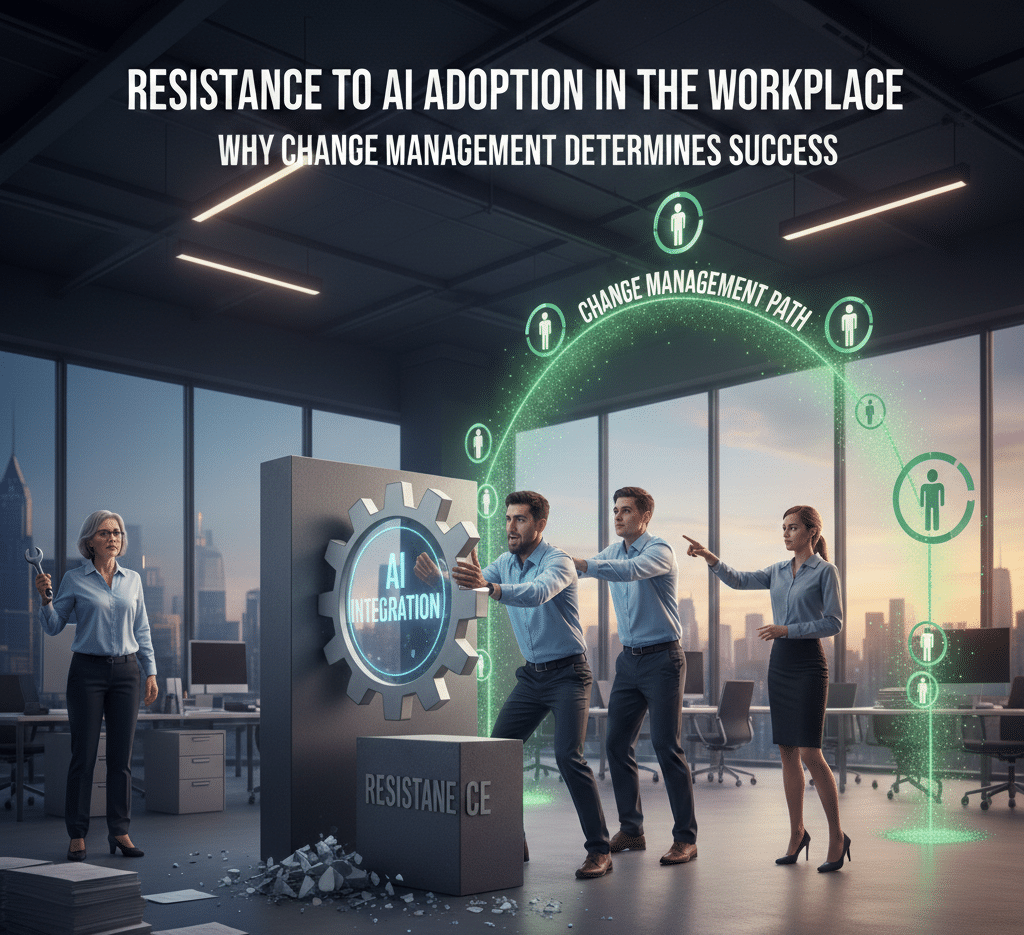
For CEOs and HR leaders, AI adoption is no longer a future discussion. It is a present reality.
For decades, organizations attempted to separate “work technology” from “personal technology.” The assumption was that employees operate in two worlds — one governed by policy and one governed by productivity.
History has proven otherwise.
- Phones merged work and home.
- Computers became personal.
- Cloud platforms made information portable.
Each time, organizations attempted to control the shift.
Each time, employees adapted first.
Now, it’s happening again — with AI.
The Data Every CEO and HR Leader Should Understand
This is not speculation. It is measurable:
- 70% of knowledge workers are already using generative AI tools outside official company policy (Microsoft Work Trend Index, 2025).
- 83% of GenAI pilots fail to reach full production (MIT Sloan & BCG, 2025).
- Smartphone computing power increased 35% year-over-year, accelerating the shift toward personal, on-device AI (Qualcomm Annual Report, 2025).
Apple has already demonstrated AI models running directly on individual devices for privacy and personalization, signaling that AI will increasingly belong to the individual — not the enterprise.
The implication is clear:
Employees are adopting AI faster than organizations are governing it.
This Is Not an IT Issue. It Is a Workforce Issue.
When 70% of your workforce is experimenting with AI outside policy, you are not driving adoption — you are reacting to it.
Employees are choosing tools that help them:
- Work faster
- Think more strategically
- Produce higher-quality outputs
- Stay competitive
The pattern mirrors the early PC era. Transformational technologies spread from the individual outward — not from the committee downward.
This is why most AI pilots stall. The 83% failure rate is not a technology problem.
It is a change management problem.
Organizations attempt to introduce AI without redesigning:
- Job roles
- Skills requirements
- Performance expectations
- Governance structures
- Leadership behaviors
AI cannot be deployed successfully without redesigning work itself.
The Strategic Imperative: Upskilling the Workforce
The competitive advantage in the AI era will not come from purchasing tools. It will come from developing AI-enabled employees.
At MindFinders, we describe this as building the AI-Enabled Superemployee.
A Superemployee is:
- AI-literate across core business functions
- Skilled in prompt engineering and AI-assisted analysis
- Trained in secure and ethical AI usage
- Capable of integrating AI into daily workflows
When employees are properly upskilled:
- Productivity accelerates
- Decision-making improves
- Innovation expands
- Risk exposure decreases
Without structured upskilling, organizations experience:
- Shadow AI usage
- Compliance vulnerabilities
- Low-return pilot programs
- Workforce anxiety and resistance
AI adoption is not a software rollout.
It is a skills transformation initiative.
Why CEOs and HR Leaders Must Lead This Shift
AI transformation cannot sit solely within IT.
It is a Human Capital Management responsibility.
It requires:
- Executive alignment and sponsorship
- Clear communication about AI’s role
- Structured training pathways
- Measurable performance metrics
- Governance that evolves with technology
Technology evolves quickly.
People adopt change deliberately.
Bridging that gap requires structured change leadership.

AI-Enabled Human Capital Management — Built for Execution
At MindFinders, we help organizations move from experimentation to execution.
AI-Enabled Human Capital Management. Built for Execution.
MindFinders helps organizations redesign work, upskill talent, and deploy AI-ready teams that deliver measurable performance — today and into the future.
With 25 years of experience partnering with federal agencies, Fortune 500 companies, nonprofits, and high-growth enterprises, we understand what many AI initiatives overlook:
Technology does not transform organizations.
People do.
And people require structured change management.
The MindFinders Approach
We support leaders through:
- AI Readiness & Risk Assessments
- Understanding current adoption, shadow AI exposure, and workforce capability gaps.
- Superemployee Upskilling Programs
Role-based AI training that includes:
- Prompt engineering
- Secure usage practices
- Workflow integration
- AI-assisted decision support
AI-Augmented Staffing
Providing AI-ready professionals skilled in tools such as:
- ChatGPT
- Gemini
- Google NotebookLM
- Enterprise AI productivity platforms
Change Management Architecture for AI
Embedding AI into governance, performance systems, and leadership structures so adoption is sustained — not temporary.

The Leadership Inflection Point
The most important question today is not:
“How do we deploy enterprise AI?”
It is:
“How do we lead when every employee has access to AI intelligence we cannot fully control?”
Because AI will increasingly:
- Run locally
- Operate privately
- Follow the individual across roles and organizations
The organizations that succeed will not attempt to suppress this shift.
They will:
- Upskill their workforce
- Align governance intelligently
- Redesign workflows intentionally
- Treat AI as a capability multiplier
From Strategy to Sustained Adoption
MindFinders assists leaders in aligning:
- Business Strategy
- Human Capital
- AI Capability
So that transformation is not just implemented — but adopted, measured, and sustained.
AI will not replace your workforce.
But a workforce trained to use AI effectively will outperform one that is not.
The organizations that embrace structured upskilling and disciplined change management will convert AI into competitive advantage.
The others will continue running pilots that never reach production.
The question is no longer whether AI will shape your workforce.
The question is whether leadership will shape AI adoption — or react to it.
That is the difference between experimentation and execution.
And that is where MindFinders leads.
Ready to Build a Smarter Workforce Strategy?
Let’s talk about how AI-enabled staffing can work for your organization — responsibly, compliantly, and with real results.
Schedule Your Free Consultation

