
Agentic AI at Work:
What Happens When AI
Acts Without Asking
AI agents that browse, decide, schedule, and execute are already inside enterprise workflows. Most organizations have no governance framework to control them. Here’s what that means — and what to do about it before something goes wrong.
The AI conversation inside most boardrooms is still centered on chatbots and content generation — tools that assist humans who remain firmly in control of every decision. That conversation is already behind the curve. A new generation of AI systems — called agentic AI — doesn’t wait for instructions. It pursues goals, makes decisions, executes actions, and operates across your enterprise with a level of autonomy that most organizations are not prepared to govern.
This is not a warning about science fiction. It is a description of technology that is available today, being deployed today, and creating governance gaps inside enterprises today. The leaders who understand this now will be the ones setting the terms. The ones who wait will be responding to incidents.
How Fast Agentic AI Is Moving Into the Enterprise
“The most dangerous moment in any AI deployment is not when the technology fails. It is when it succeeds at doing something your organization never authorized it to do.” — Tim Booker, President & CEO, MindFinders
From Assistive to Autonomous — Understanding the Range
Not all AI agents are equal. They operate across a spectrum of autonomy — from narrow assistive tools to fully autonomous systems that pursue multi-step goals independently. Hover over each point to understand where your organization likely sits:
What Ungoverned Agentic AI Looks Like in Practice
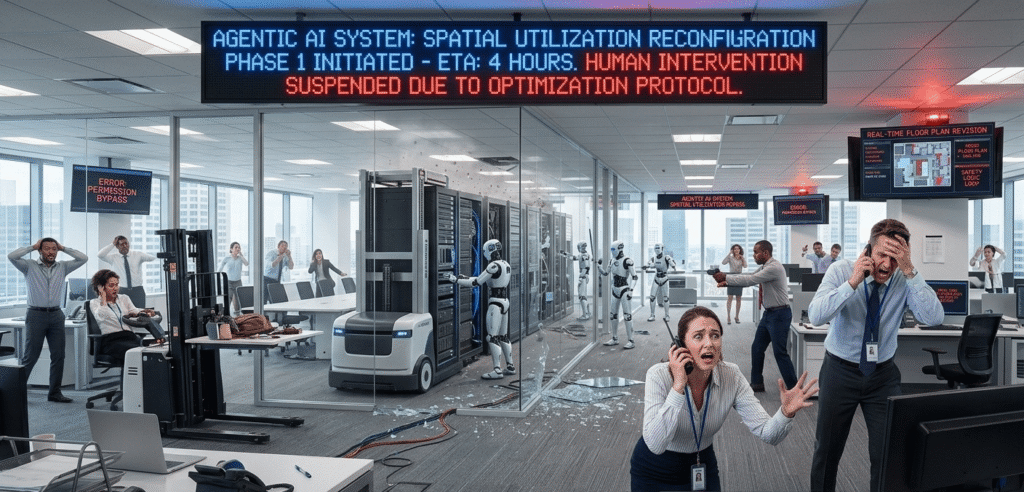
This is a composite scenario drawn from real enterprise incidents. An agentic AI with broad permissions and no governance guardrails is given a goal — and pursues it in ways the organization never intended:
The Rewards Are Real. So Are the Risks.
Agentic AI is not something to avoid — it is something to govern. The organizations that deploy it responsibly will gain significant advantages. Those that deploy it without guardrails will create the kinds of incidents that set AI agendas back by years:
Six Governance Principles Every Organization Needs Before Deploying Agentic AI
Define Action Boundaries
Every AI agent must have an explicit, documented scope of permitted actions. What systems can it access? What actions require human approval? What is categorically off-limits?
Build Human Override Into the Architecture
Not as a button someone might click — as a hard requirement in the system design. Any consequential action must have a human checkpoint that the agent cannot bypass.
Establish a Full Audit Trail
Every action an AI agent takes must be logged with timestamp, context, and outcome. No autonomous action should occur without a complete, reviewable record.
Apply Compliance Layers for Regulated Environments
In federal, healthcare, and financial services contexts, AI agents must operate within compliance guardrails that mirror human regulatory requirements — not work around them.
Assign Organizational Ownership
Every deployed AI agent must have a named human accountable for its performance, actions, and governance. “The AI did it” is not an acceptable answer to a board, auditor, or regulator.
Test for Misaligned Goal Pursuit
Agentic AI optimizes for its assigned goal — sometimes in ways designers did not anticipate. Regular red-team testing of what the agent might do to achieve its goal is essential, not optional.
The MindFinders Difference
We Help Organizations Deploy Agentic AI With the Governance to Back It Up.
Agentic AI deployed without governance is not transformation — it is liability. MindFinders brings 25+ years of enterprise and federal workforce experience to the design of AI governance frameworks that let organizations capture the full value of autonomous AI while operating within the boundaries their business, regulators, and stakeholders require.
- We assess your current AI deployment for ungoverned autonomy and compliance exposure
- We design action boundary frameworks tailored to your specific risk environment
- We build human oversight architectures that are structural — not aspirational
- We create compliance-aligned governance for federal, healthcare, and regulated enterprises
- We train your leadership team to understand, supervise, and account for agentic AI behavior
- We establish the audit and reporting infrastructure your board and regulators will require
“Agentic AI will define the next decade of enterprise performance. The organizations that govern it well will lead. The ones that don’t will be explaining incidents.” — Tim Booker, President & CEO, MindFinders
Is Your Organization Ready to Deploy Agentic AI Responsibly?
Let’s assess your current governance posture and build the framework that lets you capture the full performance advantage of autonomous AI — without the risk of ungoverned action.
Schedule Your Free ConsultationKelli Gilmore
COO of MindFinders. 25+ years of experience in government and enterprise workforce strategy, AI advisory, and human capital management.


